All-American Program
Monday, September 26, 2005,
7 PM
Herbst Theatre
The
Earplay Ensemble
Mary Chun,
conductor
Tod Brody, flutes • Peter
Josheff, clarinets • Karen Rosenak,
piano
Terrie Baune, violin • Ellen
Ruth Rose, viola • Thalia Moore,
cello
Guest Artists
Wesla
Whitfield, vocalist • Kevin
Neuhoff, percussion

Ralph
Shapey
Sonata
for Violin and Piano
(West
Coast Premiere, 1998)
Frances White
A
Veil Barely Seen
(West Coast
Premiere, 2000)
Stephen M. Gryc
Dream
Vegetables
(San Francisco
Premiere, 1997)
Bruce Bennett
from
the ashes
(World Premiere,
Earplay/Fromm Foundation Commission, 2005)
Program
Notes
Ralph Shapey, sonata (1997-98)
for violin and piano
 I.
Variations I.
Variations
II.
Rondo-Scherzando
III.
Canzonetta
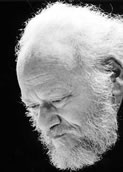 Born in Philadelphia, Ralph Shapey (1921-2005)
showed early talent as a violinist, conductor, and composer.
Compositionally, Shapey always pursued excellence in his own
style, regardless of trends; and in a world that frequently places
at least as much emphasis on the personality and image of the
artist as on his work, he uncompromisingly held the idea that
the music, once created, should stand on its own. This commitment,
along with a refusal to compromise his integrity and disillusionment
with the musical climate of the time, led him to withdraw his
compositions from 1969 to 1976, believing that people were unable
to appreciate and perform his work for its own sake. Irrespective
of controversy over his approach to music, Shapey's status in
contemporary American music cannot be ignored. Combining a deep
respect for the classical masters of the past with an interpretation
that was wholly original, he has been described as a "radical
traditionalist." Born in Philadelphia, Ralph Shapey (1921-2005)
showed early talent as a violinist, conductor, and composer.
Compositionally, Shapey always pursued excellence in his own
style, regardless of trends; and in a world that frequently places
at least as much emphasis on the personality and image of the
artist as on his work, he uncompromisingly held the idea that
the music, once created, should stand on its own. This commitment,
along with a refusal to compromise his integrity and disillusionment
with the musical climate of the time, led him to withdraw his
compositions from 1969 to 1976, believing that people were unable
to appreciate and perform his work for its own sake. Irrespective
of controversy over his approach to music, Shapey's status in
contemporary American music cannot be ignored. Combining a deep
respect for the classical masters of the past with an interpretation
that was wholly original, he has been described as a "radical
traditionalist."
In his conducting career, Ralph Shapey worked
with a number of major symphony orchestras and recorded his Rituals
for Orchestra with the London Sinfonietta. He was the founder
and music director of the Contemporary Chamber Players of the
University of Chicago, a group that celebrated its 25th anniversary
in 1989 and established a reputation for excellence under Shapey's
leadership. Its programming reflected Shapey's firm belief in
giving all styles of music a chance to be heard, regardless of
personal taste.
Notable awards and commissions include a MacArthur
Prize from the John D. and Catherine T. MacArthur Foundation
(1982); the First Prize in the Kennedy Center Friedheim Competition
(1990, for Concerto for Cello, Piano and String Orchestra);
the Paul Fromm Award (1993); a commission from the Philadelphia
Orchestra for the bicentennial of the Constitution in 1987 (Symphonie
Concertante); a commission from the Chicago Symphony Orchestra
to mark the centennials of both the orchestra and the University
of Chicago (Concerto Fantastique); and two commissions
from the Library of Congress. He was elected in 1989 to the American
Academy of Arts and Letters, and in 1994 to the American Academy
of Arts and Sciences.
top
* * *
Stephen M. Gryc, Dream Vegetables:
Six Poems of Maggie Anderson (1997) for voice, clarinet,
violin, and marimba
1.
Exposure
2.
Falling
3.
Nightmare
4.
Insomnia
5.
Recurring
6.
Flying
I met Maggie Anderson while we were both fellows
at the MacDowell Colony in New Hampshire during the summer of
1988. I was instantly drawn to her work and told her of my interest
in setting her poems about the dreams of vegetables as they grow
in the garden. The poems are certainly whimsical and clever,
but they are also beautifully crafted, full of evocative imagery
and ripe for musical use. I felt that the clearest way to project
the text of these poems was to have the vocalist speak rather
than sing the words. The rhythmic setting of the text is exact
to ensure complete coordination between the voice and the three
instruments. I am very enthusiastic about the instrumental combination
of clarinet, violin, and marimba. Even though each instrument
produces sound in a different way, providing variety, they all
are constructed predominantly of wood and are capable of blending
together their rich sounds, especially in their darker, lower
registers. The piece was begun in the spring of 1996 at the Ucross
Foundation in Wyoming and completed in the winter of 1997 at
my home in Farmington, Connecticut.
-- Stephen M. Gryc
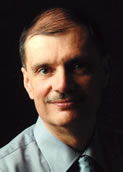 Stephen Michael Gryc was born
in St. Paul, Minnesota in 1949 but lived in Sunnyvale, California
during the 1960s. He received his professional training at the
University of Michigan, where he studied composition with William
Albright, Leslie Bassett, and William Bolcom. He is currently
Professor of Music Composition and Theory at the Hartt School
of the University of Hartford. His music is published by Alphonse
Leduc, Boosey and Hawkes, Carl Fischer, and others, and his works
have been recorded for the Capstone, Centaur, Klavier, Opus One,
and Summit labels. Stephen Michael Gryc was born
in St. Paul, Minnesota in 1949 but lived in Sunnyvale, California
during the 1960s. He received his professional training at the
University of Michigan, where he studied composition with William
Albright, Leslie Bassett, and William Bolcom. He is currently
Professor of Music Composition and Theory at the Hartt School
of the University of Hartford. His music is published by Alphonse
Leduc, Boosey and Hawkes, Carl Fischer, and others, and his works
have been recorded for the Capstone, Centaur, Klavier, Opus One,
and Summit labels.
An intimate understanding of the technique of
instruments and the imaginative use of instrumental color are
hallmarks of Gryc's music. He has written for every type of western
instrument and ensemble, from duo to large orchestra. His instrumental
expertise has brought commissions from a diverse group of leading
soloists, including oboist Bert Lucarelli, flutist John Wion,
and trumpeter Philip Smith. Gryc's most recent commissions include
a trombone concerto for Joseph Alessi, principal trombonist of
the New York Philharmonic.
Maggie Anderson (born 1948 in New York City)
has taught in the creative writing programs at the University
of Pittsburgh, Pennsylvania State University, the University
of Oregon, and Hamilton College. She currently teaches at Kent
Sate University. Among her awards are fellowships from the National
Endowment for the Arts and the Pennsylvania Council on the Arts.
Anderson’s books of poetry include Years that Answer (1980), Cold
Comfort (1986), and A Space Filled with Moving (1992).
top
* * *
Frances White, A Veil Barely
Seen (2000), for viola and electronics
Chapter 6 of the Tao Te Ching is about the Valley
Spirit, an eternal female element associated with water. In a
poetic translation by Gia-Fu Feng and Jane English, she is compared
to "a veil barely seen":
The
valley spirit never dies;
It
is the woman, primal mother.
Her
gateway is the root of heaven and earth.
It
is like a veil barely seen.
Use
it; it will never fail.
I recorded the sound of water for this piece
in the winter and early spring of 2000. Listening to the different
streams, I felt myself pulled in by the sound. The water flows
between, around, and through the rocks, and as it does, it produces
different pitches and rhythms. They change in subtle ways, depending
on where you stand. The longer I listened, the more I began to
hear. But sometimes I could not tell whether the pitches that
I heard were really there or were only sounding in my imagination.
Finally, I felt myself disappearing into the water.
A veil barely seen was commissioned
by, and is dedicated to, Liuh-Wen Ting.
-- Frances White
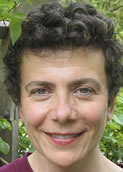 A composer of both instrumental and electronic
music, Frances White studied composition at
the University of Maryland, Brooklyn College, and Princeton University.
She has received awards, grants, and commissions from organizations
such as Prix Ars Electronica (Austria), the Institut International
de Musique Electroacoustique de Bourges (France), the International
Computer Music Association, Hungarian Radio, ASCAP, the Bang
on a Can Festival, the Other Minds Festival, the New Jersey Symphony
Orchestra, The Dale Warland Singers, the American Music Center,
The Mary Flagler Cary Charitable Trust, and the John Simon Guggenheim
Foundation. Additionally, she has received resident artist fellowships
from The MacDowell Colony and The Djerassi Resident Artists Program.
Ms. White's music can be heard on the Wergo, Centaur, Nonsequitur,
and Harmonia Mundi labels. Recently, her music was featured as
part of the soundtrack for Gus Van Sant's award-winning film Elephant. A composer of both instrumental and electronic
music, Frances White studied composition at
the University of Maryland, Brooklyn College, and Princeton University.
She has received awards, grants, and commissions from organizations
such as Prix Ars Electronica (Austria), the Institut International
de Musique Electroacoustique de Bourges (France), the International
Computer Music Association, Hungarian Radio, ASCAP, the Bang
on a Can Festival, the Other Minds Festival, the New Jersey Symphony
Orchestra, The Dale Warland Singers, the American Music Center,
The Mary Flagler Cary Charitable Trust, and the John Simon Guggenheim
Foundation. Additionally, she has received resident artist fellowships
from The MacDowell Colony and The Djerassi Resident Artists Program.
Ms. White's music can be heard on the Wergo, Centaur, Nonsequitur,
and Harmonia Mundi labels. Recently, her music was featured as
part of the soundtrack for Gus Van Sant's award-winning film Elephant.
Frances White studies the shakuhachi (Japanese
bamboo flute) and finds that the traditional music of this instrument
informs and influences her work as a composer. Much of Ms. White's
music is inspired by her love of nature, and her electronic works
frequently include natural sound recorded near where she lives,
in central New Jersey.
top
* * *
Bruce Bennett, from the
ashes (2005) for flute/piccolo, clarinet/bass clarinet,
violin, viola, cello, piano, and percussion (world premiere/Earplay
commission/Fromm Foundation)
from the ashes is based on an underlying
structural melody that provides not only melodic profile but
also form and harmonic content. This melody is not heard explicitly
throughout most of the composition, though it does surface at
a few key points. From this ur-melody, significant structural
pitches are identified and then used to generate harmonies based
on frequency modulation synthesis. This technique has proved
effective in controlling the relative consonance and dissonance
of the generated harmonic fields depending on the equivalent
relative consonance/dissonance of the melodic intervals. The
resulting series of harmonic fields creates what could be thought
of as a harmonic topography, which is then navigated by the composition.
The poetic impulse for the piece is inspired
by the myth of the Phoenix -- a cycle of destruction and rebirth.
The composition is primarily concerned with what is born out
of catastrophe. Moments of extreme violence give way to periods
of calm, and this dichotomy shapes the dialectic of the piece.
from the ashes was composed for Earplay
at the request of violist Ellen Ruth Rose and conductor Mary
Chun, and was made possible by a grant from the Fromm Music Foundation.
It is dedicated to the memory of John Rush.
-- Bruce Bennett
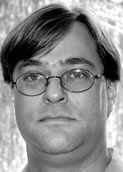 Bruce Christian Bennett received
his musical training at Reed College, where he was a student
of David Schiff; San Francisco Conservatory of Music, studying
with Andrew Imbrie, David Conte, Elinor Armer, and Alden Jenks;
and the University of California, Berkeley, where he studied
with Richard Felciano and David Wessel. Dr. Bennett is currently
Visiting Assistant Professor of Music at Tulane University. Bruce Christian Bennett received
his musical training at Reed College, where he was a student
of David Schiff; San Francisco Conservatory of Music, studying
with Andrew Imbrie, David Conte, Elinor Armer, and Alden Jenks;
and the University of California, Berkeley, where he studied
with Richard Felciano and David Wessel. Dr. Bennett is currently
Visiting Assistant Professor of Music at Tulane University.
Bennett is interested in electroacoustic music
and compositional models based on naturally occurring acoustic
and artificially generated spectra. Canciones de amor y la
noche for voice, ensemble, and electronics (1998) is representative
of this interest, as are Schematic Nocturne for solo
piano (1997) and the demon in checkered pants for brass
quintet (1997). Sketches for cello and electronics (1999/2000)
was composed for cellist Hugh Livingston as an exploration of
extended instrumental techniques magnified by real-time digital
signal processing using MAX/MSP.
Bennett's works have been performed by the Arditti
String Quartet, the Ensemble InterContemporain, Sirius, and members
of the San Francisco Contemporary Music Players; his electroacoustic
music has been presented at events such as the Electric Rainbow
Coalition Festival at Dartmouth, the Pulse Field exhibition in
Atlanta, Sonic Circuits II, Cultural Labyrinth in San Francisco,
and EX-STATIC and Sonic Residues in Melbourne.
A member of the Earplay board of directors from
2000 to 2003, Bennett was a founding member of both the Berkeley
New Music Project and the Center for New Music and Audio Technologies
Users Group, a coalition of composers and engineers whose interests
are in the interaction of music and technology.
top
Guest
Artists
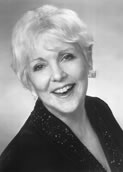 WESLA WHITFIELD (voice) inhabits
an indeterminate zone where jazz and cabaret meet. Trained in
classical music and opera, she has spent her career breathing
life into the body of Broadway tunes, movie songs, and Hit Parade
numbers known collectively as The Great American Songbook. Though
based in San Francisco, Whitfield now spends much of her time
in New York, working such noted rooms as the Algonquin Oak Room,
Jazz Standard, and Le Jazz Au Bar, and she performs frequently
at Town Hall, Avery Fisher Hall, and Carnegie Hall. Accompanied
by jazz greats Mike Greensill and John Wiitala, Whitfield’s
sixteenth recording, ‘In My Life’ on HighNote records,
was released in January of this year and is being hailed as her
finest to date. Broadcast and print media that have highlighted
her life and work include "All Things Considered," People magazine, "CBS
Sunday Morning," and The New York Times Magazine. WESLA WHITFIELD (voice) inhabits
an indeterminate zone where jazz and cabaret meet. Trained in
classical music and opera, she has spent her career breathing
life into the body of Broadway tunes, movie songs, and Hit Parade
numbers known collectively as The Great American Songbook. Though
based in San Francisco, Whitfield now spends much of her time
in New York, working such noted rooms as the Algonquin Oak Room,
Jazz Standard, and Le Jazz Au Bar, and she performs frequently
at Town Hall, Avery Fisher Hall, and Carnegie Hall. Accompanied
by jazz greats Mike Greensill and John Wiitala, Whitfield’s
sixteenth recording, ‘In My Life’ on HighNote records,
was released in January of this year and is being hailed as her
finest to date. Broadcast and print media that have highlighted
her life and work include "All Things Considered," People magazine, "CBS
Sunday Morning," and The New York Times Magazine.
KEVIN NEUHOFF (percussion) is
a soloist and new-music chamber musician who has performed with
the Cabrillo Festival, the Oakland Ballet, Left Coast Chamber
Ensemble, the Other Minds Festival, New Century Chamber Orchestra,
and the Paul Dresher Ensemble. He holds the post of principal
timpanist with the International Carmel Bach Festival Orchestra,
the Western Opera Orchestra, the Berkeley Symphony, and the Fremont
Symphony, and is principal percussionist with the Marin Symphony.
Neuhoff is frequently invited to play with the San Francisco,
Oakland, Santa Rosa, and Sacramento Symphonies and can be heard
on recordings made on the Harmonia Mundi, Triloka, New Albion,
Wide Hive, and Nonesuch labels.
top
Program notes edited by John H. Mugge |